From Sketch to Screen: The Anatomy of a Festival-Ready Short Film
Every short film begins the same way: a blank page and an unreasonable amount of optimism. What separates the films that screen at festivals from the ones that never leave the hard drive is everything that happens between that first sketch and the final export.
This is the story of one film's journey — from a pencil drawing on a kitchen table to a packed theater in front of a festival audience — and the philosophy that guided it through every stage.
The Storyboard Is the Script
Most directors treat storyboards as pre-visualization. Anton Park treats them as the first edit.
Before a single location was scouted or an actor was cast, the entire film existed as forty-one frames drawn in graphite. Each panel represented a shot, and each shot had to earn its place. If a frame couldn't justify why it needed to exist — why it wasn't the frame before it or the frame after it — it was cut before it ever cost a dollar.
The discipline is simple but unforgiving: a short film has no room for filler. A feature can absorb a lazy scene. A ten-minute short cannot. The storyboard phase is where the film is won or lost, and the drawing board is where the editor's job quietly begins.
Location, Light, and the Economics of Restraint
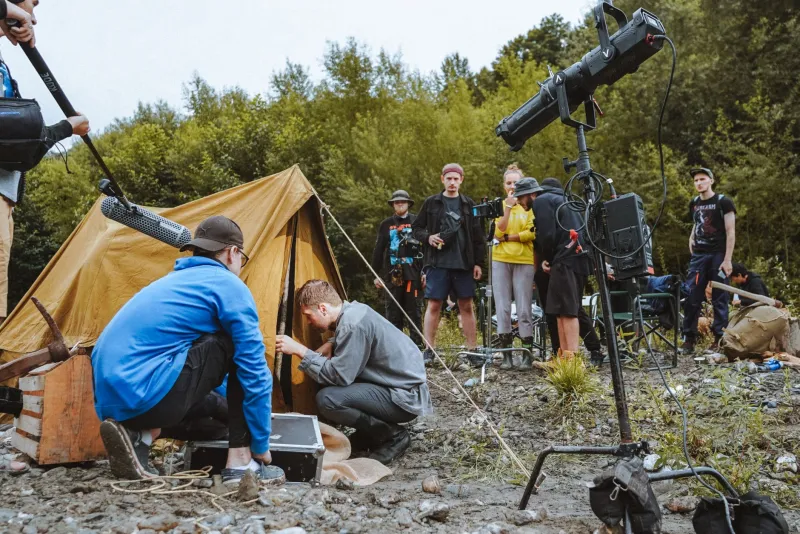
Park's productions are famously lean, and not by accident. The film was shot over four days in two locations — a rented craftsman house in Los Angeles and a stretch of Pacific Coast Highway at golden hour.
The gear list reflected the same restraint. A single cinema camera, two prime lenses, and a lighting package that fit in one van. The choice wasn't financial vanity; it was speed. Fewer tools mean fewer decisions, and fewer decisions mean the crew's energy goes toward performance and composition rather than logistics.
The golden-hour sequence is a case study in patience. The crew had a window of roughly forty minutes each evening. Two evenings of shooting produced ninety seconds of usable footage. On the editing timeline, those ninety seconds carry the emotional weight of the entire film.
Editing as Sculpture, Not Assembly
Post-production followed a rule that Park repeats to every collaborator: cut for tension, not for clarity.
The first assembly ran eighteen minutes. The final cut runs eleven. The difference wasn't trimmed exposition — it was trust. Trust that the audience will infer a relationship from a single glance. Trust that silence, held two seconds longer than comfortable, communicates more than a line of dialogue.
Sound design received as much attention as the image. Roughly a third of the post-production schedule was devoted to audio: room tone recorded on location, foley captured in a garage-turned-booth, and a score recorded with a three-piece ensemble over a single weekend. Festivals screen in theaters with serious sound systems, and a mix that holds up on headphones will not always hold up in a room with a subwoofer the size of a dishwasher.
Color, Titles, and the Last Ten Percent
The grade was kept restrained — a warm, slightly desaturated palette that let skin tones lead. The titles were set in a single typeface, on screen for less time than it takes to read this sentence. Restraint, again.
The last ten percent of a film's production is where most shorts reveal their amateur status: rushed color, temp music that never got replaced, credits that look like they were typeset in a word processor. Every one of those details is a frame, and every frame is part of the argument you're making to a festival programmer.
The Submission Circuit: A Campaign, Not a Lottery
A finished film is not a finished project. The festival strategy was mapped with the same care as the shot list.
The film premiered regionally, targeting festivals known for discovering emerging directors rather than chasing prestige names out of the gate. Each submission was tailored — different cuts for different programs, where the festivals allowed it, and a press kit assembled before the first acceptance letter arrived.
Rejections outnumbered acceptances, as they do for everyone. The lesson of the circuit is that persistence is a craft skill. A short film's life is measured in years, not weeks.
What the Journey Teaches
The film that started as forty-one pencil frames ended as a calling card — one that opened doors to meetings, funding conversations, and a place in the festival conversation.
For filmmakers setting out, the takeaway is not the specific gear or the specific festivals. It's the philosophy underneath: treat every frame as a decision, every decision as a promise to the audience, and every stage of production as part of the same continuous act of storytelling.
Cinema lives in every frame. The work is making sure yours can prove it.