Reels Before the Ruin: Anton Park's 16mm Pilgrimage to America's Last Single-Screen Theaters
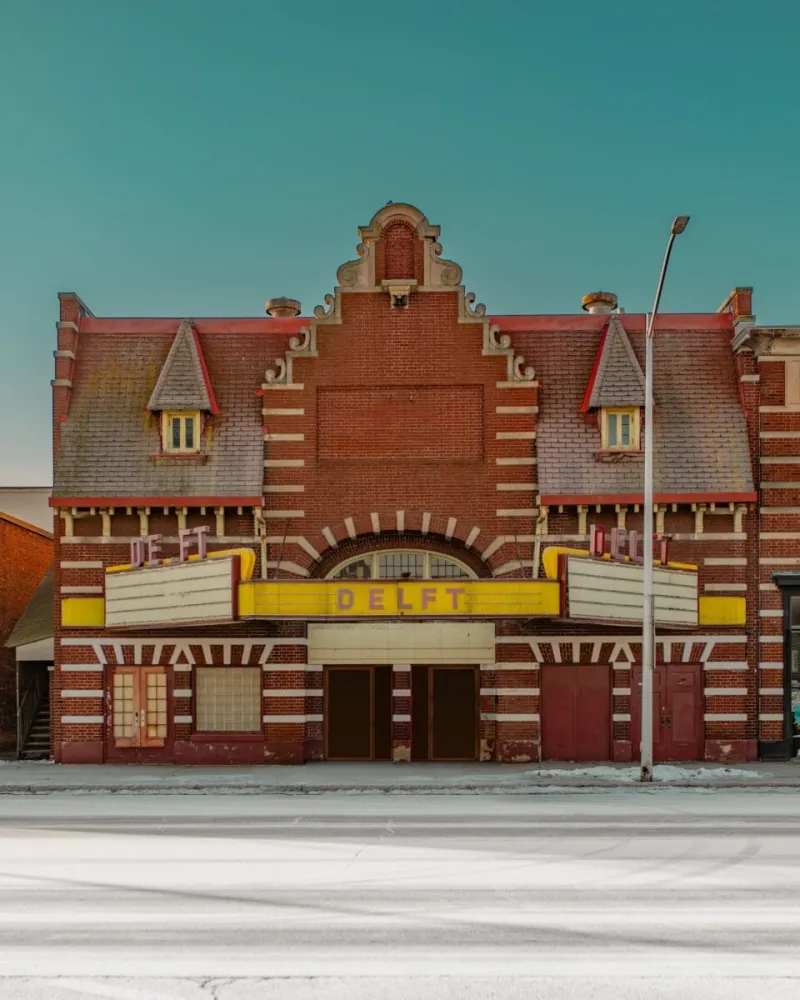
Photo: abandoned vintage single-screen movie theater marquee small town America, via www.thisiscolossal.com
There is a moment in nearly every Anton Park film that regular viewers have learned to anticipate: a theater. Sometimes it is functioning, its marquee buzzing with letters that spell out someone's small salvation. More often it is shuttered, the lobby carpet worn down to the nap, the projection booth dark for years. Park does not treat these spaces as backdrops. He treats them as characters — and like the best characters, they are based on real people who are running out of time.
Since 2021, Park has been conducting a quiet side project that has never appeared in his press materials: a personal archive of America's remaining single-screen movie houses, shot exclusively on 16mm, much of it on expired stock he buys in lots from closing labs. The project has no title, no distributor, and no announced release. It exists, for now, as roughly forty reels in a climate-controlled storage unit in Ohio.
Why 16mm for Buildings That Are Already Fading
The choice of format is not nostalgic posturing, Park insists. It is diagnostic.
"If I shoot a 1948 theater on a modern digital sensor, I get a picture of a building," he said during a break between location scouts. "If I shoot it on grain that's already degrading, the film and the theater are doing the same thing at the same time. The emulsion is failing the way the plaster is failing. That's not a metaphor I'm imposing. It's a collaboration."
The expired stock produces unpredictable results — halation around marquee bulbs, color shifts that turn velvet curtains odd shades of rust and violet. Park considers these artifacts part of the record rather than flaws in it. A theater struggling to survive, he argues, should not be documented in a format that pretends nothing decays.
The Midwest Circuit
Park's route follows the old studio distribution lines: Dayton, Fort Wayne, Terre Haute, the smaller prairie towns where a single screen once served three generations. Many of these houses opened between 1915 and 1940, survived the multiplex era by sheer stubbornness, and are now meeting a slower end — declining attendance, unpayable roof repairs, heirs who live three states away.
What surprises him most, he says, is not the decay but the stewardship. Volunteers in their seventies run Saturday matinees on projectors they learned to thread as teenagers. A hardware store owner in rural Indiana bought his town's theater at a tax auction and now screens second-run films every weekend at a loss he declines to discuss.
"These aren't ruins," Park said. "Ruins have given up. These places are being kept alive by hand, like a fire that keeps going out."
How the Theaters Enter the Films
The documentary project and the narrative work feed each other in ways that are easy to miss on first viewing. The shuttered cinema in his acclaimed short Secondhand Souls was a real house in Mansfield, Ohio, closed for eleven years at the time of shooting. The projection booth sequence — a single unbroken take lit only by the booth's dust-filled light — was built around the actual geometry of that room. Park has said he could not have designed a better space, and did not try.
More broadly, the archive has changed how he stages interiors. Time spent in these theaters taught him how light falls through a vertical space built for darkness, how sound behaves in a room designed to hold a few hundred held breaths. His features borrow that acoustics unconsciously. Audiences feel it before they can name it.
Three Marquees on Borrowed Time
The project has an urgency that Park does not enjoy discussing. Three theaters on his list are in active jeopardy, and he has scheduled shoots around their demolition timelines rather than his own production calendar.
The first is a 1920s atmospheric house in southern Illinois, its ceiling painted as a night sky, slated for structural assessment that its owners may not survive financially. The second, a Art Moderne theater in western Ohio, sits in a downtown redevelopment zone; the city has been courteous, Park says, but the drawings do not include the building. The third he declines to name publicly — a habit he adopted after a previous location suffered a break-in within weeks of appearing in a local news feature.
"I've made my peace with losing them," he said. "I just haven't made my peace with not having been there."
What Is Lost When a Screen Goes Dark
Film culture conversations in the United States tend to center on production — tax incentives, soundstages, streaming deals. Park's archive makes a different argument: that the exhibition infrastructure of small-town America was itself a cultural institution worth recording, and that its loss is a loss of public interior space that nothing has replaced.
A single-screen theater was often the largest room in a town — the place where a community gathered in the dark, faced the same direction, and reacted together. Parks, libraries, and churches serve other purposes. The economics that replaced these houses with four-screen multiplexes and then with living rooms did not replace their civic function.
Whether the archive will ever become a film of its own, Park will not say. He describes it as "a debt being paid in installments." For a director whose features are built on patience and on trusting that the frame can carry meaning without commentary, an unfinished, undistributed body of work may be the most consistent project he has ever undertaken.
The reels keep accumulating. The wrecking schedules keep advancing. Somewhere in the Midwest, a marquee is flickering through its last season, and a man with a wind-up camera is already on his way.