Secondhand Souls: Why Anton Park's Characters Wear the Dead's Clothes
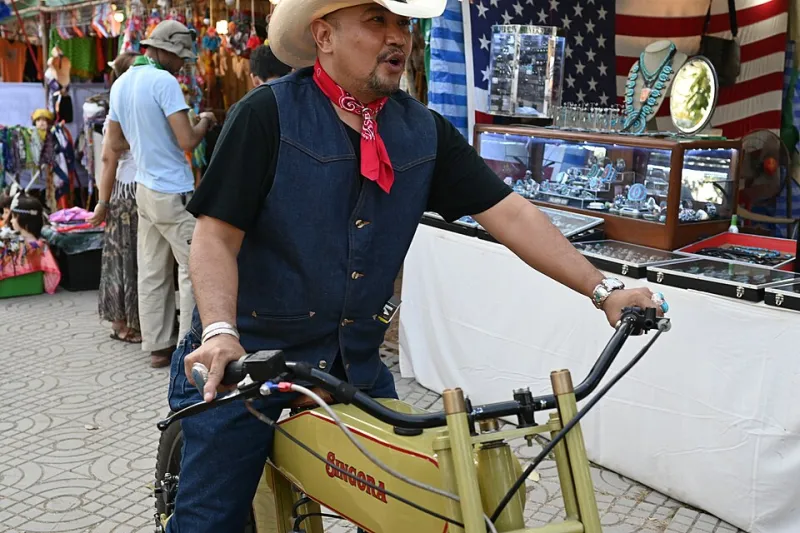
Photo: PattayaPatrol, CC BY-SA 4.0, via Wikimedia Commons
There is a moment in Anton Park's short film Hallow Ground — barely two seconds long — when a widow smooths the lapel of a denim jacket across her shoulders. The jacket is stiff in the wrong places. The left cuff is worn to a pale fray. Nothing about it reads as costume, because it isn't one. Park bought it at an estate sale outside Wichita, from the family of a wheat farmer who had worn it for thirty-one years.
"A rental house can give you a jacket that looks old," Park says. "It cannot give you a jacket that was loved. The camera knows the difference. Audiences know the difference, even if they can't articulate why."
The Warehouse Problem
The standard American indie pipeline runs through the same handful of costume houses — Western Costume in Los Angeles, its East Coast rivals, their regional brokers. The garments are immaculate, catalogued, and available in every size by Tuesday. They are also, in Park's estimation, emotionally sterile.
"Rental clothes have been worn by a hundred productions," he explains. "They've been altered, laundered, re-stitched. They belong to no one. My characters arrive somewhere. They have a mother, a late husband, a job they've held for decades. Their clothes should carry that weight before the first line of dialogue."
For a filmmaker whose work trades in silence and sustained observation, costume is not decoration. It is exposition. A hemline can do the work of a monologue.
The Estate-Sale Circuit
Park's method is unglamorous and largely solitary. He arrives in a town days before his crew does — often alone, sometimes with a single assistant — and works the circuits that locals already know: estate sales listed on EstateSales.net, church rummage sales advertised in parish bulletins, VFW auxiliary tag sales, the weekend tables outside Methodist halls in towns like Marion, Ohio, and Salina, Kansas.
The rules he follows are strict. He buys from families, not resellers. He asks about the garments and listens. He pays asking price without negotiation, particularly when the seller is a grieving relative. "You are not thrifting," he says. "You are being entrusted with something."
The 1962 prom dress that appears in his festival darling Chalk Lines came from an estate sale in Dayton — taffeta the color of weak tea, a hand-sewn hem, a name penciled inside the bodice. Park kept the name. He sent the family a photograph of the actress wearing it at its premiere.
What History Costs
The economics are almost absurd. A period-appropriate rental for a short film might run several hundred dollars per garment per week, with damage waivers and alteration fees stacked on top. Park's entire costume budget for Chalk Lines was under $900 — including gas, motels, and a hand-stitched repair done by a retired seamstress he met at a Topeka rummage sale who now works on every production he shoots in Kansas.
But the real return is textural. Vintage fabrics drape differently. Pre-1980s denim fades in patterns synthetic reproductions cannot fake. A dress worn to one prom and fifty years of Sunday services moves on the body in a way nothing manufactured for the rack ever will.
A Quiet Movement
Park is not alone. A small cohort of American directors — mostly working in the plains states and the industrial Midwest — have quietly abandoned the rental pipeline for the estate-sale route. They are cagey about naming towns or specific sales, protective of the ecosystems they depend on. What they will say, uniformly, is that the clothes changed their films.
"Every garment is a biography," Park says. "When an actor puts on a dead man's jacket, they don't perform grief. They inherit it."
For a cinema built frame by careful frame, that inheritance might be the most valuable thing on set.