Tears on Cue: Inside Anton Park's Stunt-Style Rehearsal Room
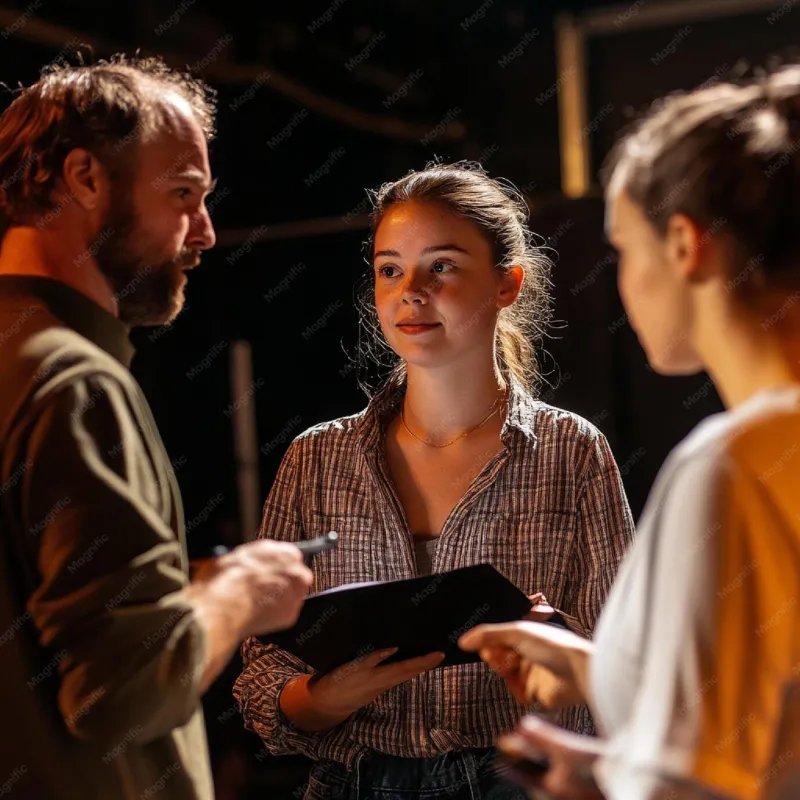
Photo: actors rehearsing emotional scene in rehearsal studio with director, via img.freepik.com
In a converted warehouse in Queens, a week before cameras rolled on Anton Park's latest short film, an actress stood alone under practical lights and wept. Not once. Eleven times, on request, each take timed to the second by a stage manager with a stopwatch. Nobody called it a breakdown. They called it rehearsal.
Park, whose shorts have circulated through the festival circuit from Sundance's shorts programs to regional showcases in Austin and Chicago, has become known among collaborators for a rehearsal process that borrows less from Method acting lore and more from the stunt coordination playbook. Scenes built around emotional peaks — a confession, a collapse, a quiet unraveling — are treated the way a fight choreographer treats a fall: repeated, mapped, and made safe enough to execute at full intensity.
The Cry Count
Performers who have worked with Park describe a vocabulary that sounds borrowed from a second unit. There are 'cry counts,' in which an actor must produce tears within a specific number of breaths. There are 'tremble takes,' where the physical shudder of fear or rage is isolated and drilled until it can be summoned without the actor needing to dredge up the feeling from scratch.
One actress, speaking on the condition that her current project not be named, recalled the process with a mixture of exhaustion and gratitude. 'On day two, he asked me to hit the crying beat four times in a row, exactly the same, like a dancer running eight counts. By the fourth time, something strange happened. I stopped performing the sadness and started performing the scene. The sadness was just... loaded.'
Park's argument, delivered in conversation with characteristic bluntness, is that improvisation fails on camera more often than it succeeds. 'A stunt doesn't work because the stunt performer felt like falling that day,' he says. 'It works because it was designed. Emotion is the same. The audience can't tell the difference between a real feeling and a prepared one. But the director can, and the editor definitely can.'
Precision Staging for the Heart
The mechanics of Park's method are unglamorous. Emotional beats are broken into physical components: breath rhythm, eyeline shifts, hand placement, the moment weight transfers from one foot to the other. Actors rehearse these components separately before assembling them, the way a fight coordinator drills a punch before attaching it to a sequence.
Safety protocols apply, too. Park caps the number of full-intensity emotional runs per day, treating vocal strain and emotional depletion the way a stunt team treats fatigue — as a hazard that produces bad takes and, occasionally, real harm. If an actor signals they've hit their limit, the scene is reblocked or rescheduled. There is no pressure to 'stay in it' between setups.
This stands at odds with the prevailing mythology of American independent film, in which the best performances are presumed to be accidents — lightning caught once, at great cost, on the third or fourth hour of improvisation. Park's counterargument is an economic one as much as an artistic one. Short films run on tight schedules and borrowed crews. A director who needs fourteen takes to find a genuine sob is a director who loses the location at golden hour.
What the Actors Say
Not every performer initially embraced the approach. One actor described his first Park rehearsal as 'deeply unromantic,' recalling a session in which he was asked to perform a scene of grief as pure blocking, no feeling required, until the physical pattern was automatic. 'I thought it was going to kill the spontaneity. Instead, it did the opposite. Once my body knew where to go, I had room to actually be there.'
Critics of the method would argue it risks mechanical performances — emotion executed rather than experienced. Park's answer lives in the footage. In his 2023 short that screened on the festival circuit, the climactic breakdown scene was reportedly achieved in two takes, both usable, both nearly identical. The editor chose between them based on a breath, not a performance.
A Craft Discipline, Not a Formula
Park is careful to note that the method is a framework, not a straitjacket. Actors are encouraged to alter the physical pattern mid-take if a genuine impulse arrives — the choreography exists to be broken, but only by someone who has earned the break. 'The drill is the safety net,' he says. 'If the real thing shows up, we keep it. If it doesn't, we still have something true.'
In an industry obsessed with the myth of the accidental masterpiece, Park's rehearsal room makes a quieter claim: that the most vulnerable moments on screen can be the most rigorously prepared, and that nobody needs to know how many times an actor cried to get there. The tears arrive on cue. The audience claps for the film. The stunt, as ever, goes unapplauded — which is exactly how Park prefers it.