Vault of the Unfinished: Inside Anton Park's Library of Beautiful Failures
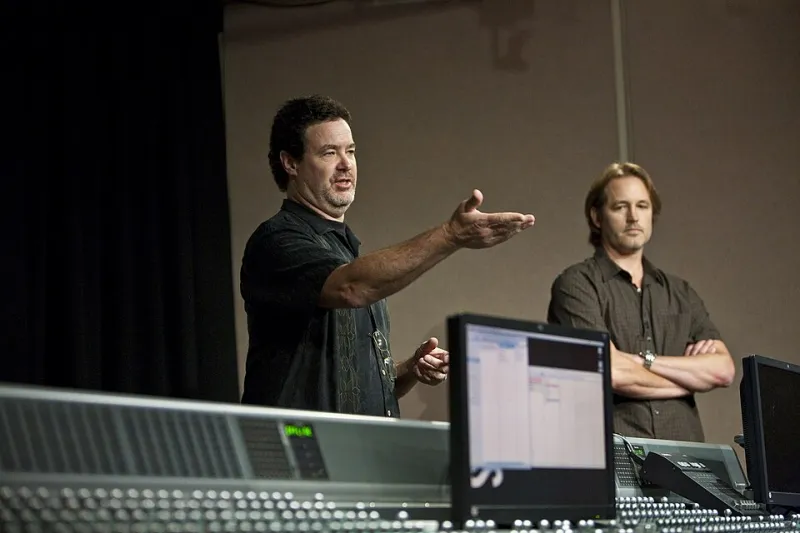
Photo: Kent Madsen, CC BY-SA 2.0, via Wikimedia Commons
The storage unit sits behind a tire shop on the outskirts of Albuquerque, in a row of beige metal doors indistinguishable from the ones holding other people's holiday decorations and defunct businesses. Inside, under controlled humidity and a temperature that never wavers, is the other filmography of Anton Park — the one no festival has ever seen.
Shelved in acid-free boxes are hundreds of rejected takes. Overexposed and underdeveloped 16mm stock from his early years in New Mexico. A nearly finished short from 2016 that he abandoned three weeks before picture lock. Sound recordings of rooms he decided not to use. Test reels where the gate was dirty, the focus was soft, the actor broke, the light died. Park refers to it, without irony, as his archive of evidence.
"Every finished film is an argument," he says. "Every failed take is a confession. I trust the confessions more."
The Case Against Disposal
Park's vault raises a question most working directors avoid: what happens to the material that doesn't make it? In the digital era, the answer is increasingly nothing. Hard drives fail. Formats become unreadable. Production hard drives get wiped to make room for the next job, and with them goes an entire education — the alternate performances, the compositions that didn't work, the evidence of how a director actually thinks when no one is grading the result.
Park, who shoots primarily on film, has a practical excuse: negative is expensive, and it doesn't delete itself. But he has spent years preserving his failures with the same care studios reserve for completed features. Outtakes are logged, dated, and annotated in pencil. Abandoned projects get a written postmortem — a few pages on why they died, stored alongside the remains.
"When I abandon something, I write down why," he explains. "Not for anyone else. For the version of me who gets excited about the same idea four years later. That guy needs to read the autopsy."
What Failure Teaches That Success Can't
Spend an afternoon with the vault and a pattern emerges. The rejected takes are rarely failures of craft; they are failures of intent. A beautifully composed shot of a diner at dawn, rejected because, in Park's words, "the frame was answering a question nobody asked." A take discarded because an extra in the background glanced at the camera — a flaw, technically, that Park now says he'd keep.
This is the vault's real function. It is not nostalgia; it is calibration. Park returns to it before every production, not to repeat old ideas but to retrace his own reasoning. The mistakes map his evolution more precisely than any completed film, because completed films are compromises — negotiated with budgets, weather, and time. The failures are pure intention, unedited.
"A finished film tells you what I settled for," he says. "The outtakes tell you what I actually wanted."
Polish, Festivals, and the Fear of the Flaw
Park is pointed about the festival circuit's role in all this. American festivals, he argues, have trained a generation of filmmakers to present only their most sanitized selves — the two-minute proof-of-concept, the immaculate short, the reel engineered to survive a programmer's ninety-second attention span. The economics are understandable. The cultural cost, he believes, is a profession that hides its process even from itself.
"We've built an industry where admitting you don't know something is a career risk," he says. "So everyone curates. Everyone performs certainty. And then a director gets on a set for the first time with real money and discovers they've never actually seen what failure looks like — because they deleted all of it."
His counterproposal is modest but radical: archives, not highlights. He has begun showing select outtakes to collaborators before production — not as reels, but as dossiers. A cinematographer joining his next project will see the abandoned 2016 short, not the award-winning one. "I want them to know where the bodies are buried," he says. "It saves us from digging the same graves."
Digital Impermanence and the Analog Argument
There is also a preservation argument, one that extends beyond one director's eccentricity. Film stock, kept properly, lasts a century. A ProRes file on a failing drive lasts until the next software update. Park is not a Luddite — he conforms, color-grades digitally, and delivers in every modern format — but he notes that the industry's shift to ephemeral storage has coincided with its shift to disposable process.
"The studios used to keep everything," he says. "Outtakes, script pages, test screenings, memos. Film historians built careers on those archives. Now the record of how movies get made is a folder marked 'render_final_v7_FINAL.' We are generating more footage than any generation in history and remembering less of it than any generation before."
The Vault as a Work in Progress
Park has no plans to release the archive publicly, at least not in his lifetime. A few selections appeared in a retrospective at a Southwest university film program last year — fogged frames, dead takes, and all — and he describes the student response as the most meaningful of his career.
"They expected a masterclass," he recalls. "What they got was two hundred ways I got it wrong. Half of them came up afterward and said it was the first time filmmaking felt possible to them."
That, ultimately, is his thesis. The vault is not a monument to failure; it is an argument against shame. Somewhere behind that tire shop in Albuquerque, in boxes labeled in pencil, sits the most complete record of how one director actually works — uncertain, wrong often, and unwilling to let the evidence disappear.
"Polish is for the audience," Park says, closing the door. "The mess is for the maker. And the maker should never be allowed to forget it."