Watercolor Prophecies: The Color Scripts That Decide a Film's Fate Before Day One
The Edit Bay Wall
Walk into Anton Park's post facility in Queens and your eyes will find the wall before they find anything else. Strips of Pantone chips run floor to ceiling, taped and re-taped, annotated in pencil. A visitor once assumed they were decoration. Park corrected them gently: the wall is the film.
For the production team behind his forthcoming short Salt Flats, NY, that wall told the whole story months before principal photography. The palette ran from a desaturated slate blue on the left — the opening act, a marriage going cold — through a muddy intermediate green, and ended in a single, aggressive amber chip near the door. The emotional arc of a twelve-minute film, reduced to roughly eighteen squares of color.
Painting the Film First
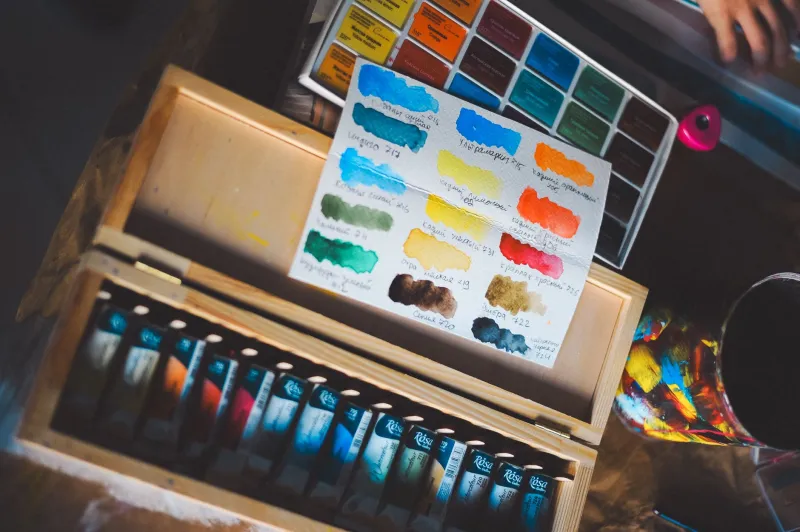
Park's process begins not with shot lists or casting sessions but with watercolor. Working in long horizontal strips — a format borrowed from the color scripts popularized by Pixar's art department, though Park's are looser, moodier, more impressionistic — he paints every scene of a film as a small abstract wash. No figures. No compositions. Just light and temperature.
"If I can't feel the temperature of a scene before it exists," Park says, "then I don't understand the scene yet. The watercolor forces honesty. You can't hide behind an actor's performance or a beautiful location. It's just hue and feeling."
The Salt Flats, NY scripts took six weeks. Early strips were dominated by cool cerulean washes bleeding into gray — the visual language of distance between two people. The final third turned almost violently warm, watercolors layered so thickly the paper buckled. Director of photography Mara Ellison received high-resolution scans of these strips alongside the standard shot lists, and by her account they did more work than any lens memo could.
From Wash to Swatch
The translation from paint to production happens through a deliberately unglamorous middle step: the Pantone wall. Each painted scene is matched to physical color chips, which are then grouped by act and taped into sequence. These become the reference points for three departments at once.
- Production design sources props and set dressing against the chips, sometimes repainting walls twice to hit a value.
- Wardrobe builds costumes that will read correctly under the planned lighting temperature, not just on the rack.
- Camera and lighting plan gel packages and practical bulbs around the target color temperature of each sequence — 3200K interiors for the cold act, contaminated sodium-vapor sources for the warm one.
On a short film budget, this discipline is not an affectation. When you have four days and no reshoots, deciding the mood in advance is the difference between a film and footage.
Engineering an Arc in Kelvin
The most instructive example of the method's power is also its most invisible. In Salt Flats, NY, the central couple's argument — the film's turning point — was staged at dusk, neither fully day nor fully night. On paper it reads as a scheduling convenience. In the color script, it is the hinge of the entire piece: the only strip painted in two temperatures at once, cool light falling on one actor's face and warm light on the other's.
Ellison achieved the effect with a single large source rigged outside a window, gelled half in CTB and half in full CTO, splitting the frame down the middle. Audiences at the film's first test screening never consciously registered the split. They only reported that the argument "felt like the end." That is the intended outcome. Park's color work is designed to be felt and forgotten, operating below the threshold of attention.
The final amber chip on the edit bay wall — the one near the door — corresponds to the film's last shot: a kitchen at sunrise, overexposed on purpose. Park kept the chip taped up through the entire post process, checking every colorist pass against it. When the final grade came back within a hair of the chip, he signed off in eleven minutes.
Why It Matters
There is a persistent myth in independent American cinema that style is something you find in the edit, or worse, something you borrow from a reference reel the night before. Park's palette boards argue the opposite: mood is a production decision, made early, made concretely, and made in a medium — watercolor — that permits no cheating.
For filmmakers, the takeaway is less about paint than about commitment. Whether the medium is chips, swatches, or crayons, the discipline is the same: know the temperature of your story before you ask anyone else to stand in it.